
Every great building begins as a sketch — a rough outline of space, function, and aspiration. But the journey from that first pencil mark to a set of legally submittable, fully coordinated construction documents is one of the most technically demanding workflows in engineering. At TechVisionEra Engineering, we manage this entire process using a BIM-first methodology that compresses timelines, eliminates costly clashes, and delivers permit-ready drawing packages to clients across the Middle East, Europe, and beyond.
This guide walks through every phase of the architectural design process — from conceptual sketching through BIM-coordinated construction documents (CDs) — explaining what happens at each stage, what you as a client can expect, and why integrated delivery under a single engineering team consistently produces superior outcomes in cost, programme, and build quality.
Phase 1: Pre-Design Analysis and Concept Development
Before a single line is drawn, TechVisionEra's architectural design team conducts a thorough pre-design analysis. This includes reviewing the project brief, existing site surveys, zoning regulations, height restrictions, local building codes, and the client's operational and aesthetic aspirations. Whether the project is a mixed-use tower in Riyadh, a residential compound in Damascus, a commercial facility in Frankfurt, or a hospitality development on the Mediterranean coast, the constraints are unique — and they must be fully understood before any design direction is proposed.
The output of the pre-design phase is a concept design package: annotated freehand sketches, digital massing studies, site relationship diagrams, sun-path and shadow analyses, and an initial space programme matching required areas to the brief. Our architects explore multiple spatial concepts simultaneously, typically presenting two or three distinct directions to the client with clear commentary on how each responds to programme, budget, urban context, and site conditions. This structured diverge-then-converge approach avoids the common failure mode of committing too early to a single direction that later proves technically or commercially problematic.
Early concept development is also where strategic decisions about structural system and building services strategy are made in outline. Engaging our structural engineers and MEP coordinators at concept stage — rather than after the architectural design is locked — prevents the single most expensive category of rework: discovering that a preferred spatial arrangement is incompatible with an efficient structural grid, or that a desired ceiling height leaves insufficient depth for coordinated services.
Phase 2: Schematic Design — Translating Vision into Scaled Geometry
Schematic Design (SD) is the phase in which the preferred concept is developed into a coherent, scaled spatial layout. Floor plans, building sections, and primary elevations are produced at a level of detail sufficient to communicate room adjacencies, circulation hierarchies, structural bay geometry, and the character of the building envelope. SD drawings are not construction-ready documents — they are design intent documents, used for client approval, planning pre-applications, and early-stage cost estimation by a quantity surveyor.
At TechVisionEra, schematic design is authored directly inside a BIM authoring environment — Autodesk Revit — rather than as 2D CAD linework that is later re-modelled in three dimensions. This discipline, starting BIM from the first design iteration, means that every wall, floor slab, roof element, and staircase is a parametric object carrying properties such as fire rating, material specification, and thermal performance data. When the client requests a layout revision — and they always do — that change propagates automatically across all dependent views: sections, elevations, area schedules, and door schedules update without requiring manual redrafting of every sheet.
Typical SD deliverables include:
- Site plan with building footprint, setbacks, and access routes
- All-level floor plans (1:200 or 1:100 scale as appropriate)
- Key longitudinal and transverse building sections (minimum two of each)
- All principal elevations showing facade character and material intent
- 3D rendered massing views for client presentation and planning submissions
- Preliminary room area schedule cross-referenced to the project brief
- Outline specification identifying key structural system and envelope materials
Phase 3: Design Development — Where All Disciplines Converge
Design Development (DD) is the most coordination-intensive phase of the entire process. It is here that the architectural intent must be definitively reconciled with structural engineering requirements, building services system design, energy performance targets, fire strategy, and — for projects with significant interior scope — the early input of our interior design team. The quality of DD coordination is the single greatest predictor of how smoothly a project will run on site.
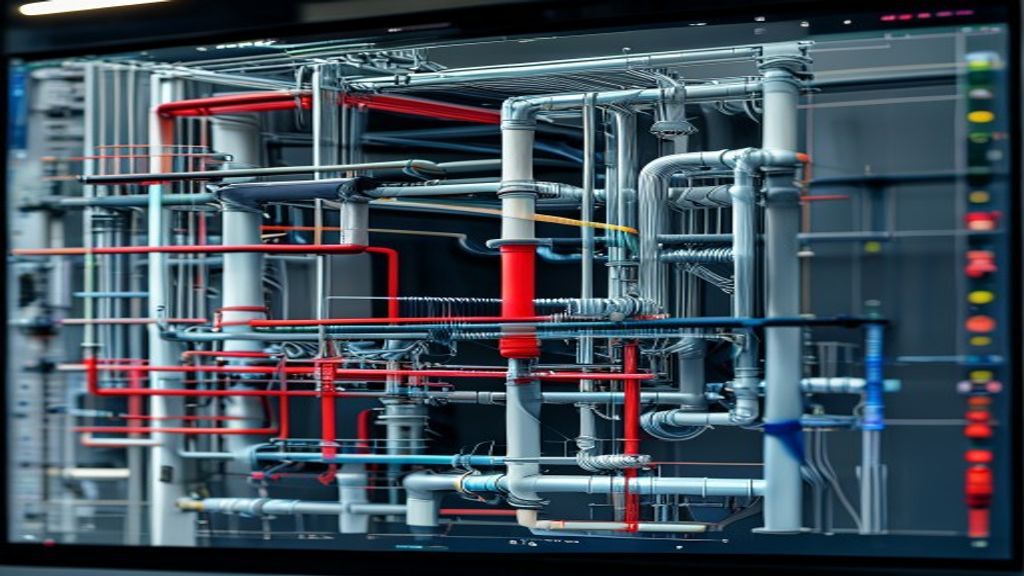
Using a federated BIM model — where the architectural model, the structural model from our structural engineering team, and the MEP model from our MEP engineers are linked together inside Autodesk Navisworks — the full project team runs formal clash detection sessions at regular intervals throughout DD. Three categories of clash are investigated: hard clashes, where elements physically intersect (a structural beam cutting through a ventilation duct); soft clashes, where clearance distances are violated (a pipe routed without maintenance access); and workflow clashes, where construction sequence conflicts arise (a suspended ceiling installed before a structural connection above is accessible). Every detected clash is logged in a Clash Detection Register, assigned to the responsible discipline, and tracked to resolution before the phase concludes.
Every clash resolved in the BIM model costs a fraction of what the same conflict costs when discovered during construction — industry data consistently puts that ratio at 1:10 or worse for complex building types.
DD deliverables are substantially more detailed than SD. They include fully dimensioned architectural plans with all walls set out to face of structure, detailed wall sections showing insulation build-up and membrane continuity, first-pass MEP layout drawings showing primary distribution routes and riser strategy, and preliminary structural member sizing from our structural team with indicative connection details. At the end of DD, a reliable quantity surveyor can produce a cost estimate accurate to within ±15% — precise enough for budget confirmation and, for public sector or publicly funded projects, formal cost approval.
Phase 4: BIM-Coordinated Construction Documents
Construction Documents (CDs) are the legal and contractual set of drawings, schedules, and specifications used to obtain building permits, solicit contractor bids, and physically build the project. They must be complete, unambiguous, dimensionally coordinated across all disciplines, and internally consistent. Achieving this with a multi-discipline team — potentially distributed across different cities and time zones — is precisely the challenge that BIM coordination is designed to solve.
TechVisionEra's CD packages are produced directly from the fully coordinated federated model after all identified clashes are resolved and all major design decisions are frozen. Each discipline issues its final drawings from its own Revit model — but all models share a common coordinate origin, a common structural grid, and agreed LOD (Level of Development) targets. The result is that architectural drawings and structural drawings always agree on grid lines, slab thicknesses, and opening sizes; MEP drawings show services within the zones allocated in DD; and coordination drawings for congested zones (plantrooms, service corridors, ceiling plenums) show all disciplines simultaneously in a format the contractor can directly use for installation sequencing.
A complete TechVisionEra BIM-coordinated CD package typically contains:
- Fully dimensioned architectural plans, sections, and elevations at 1:50 and 1:100
- Interior enlarged floor plans and reflected ceiling plans
- Comprehensive door, window, ironmongery, and room finish schedules
- Facade and wall section details at 1:10 and 1:20 showing construction methodology
- Structural general arrangement drawings with member schedules and connection details
- Reinforcement drawings and foundation design drawings
- MEP services drawings: HVAC, drainage, cold/hot water, electrical distribution, data
- Multi-discipline coordination drawings for high-density service zones
- Project specification document covering workmanship, materials, and performance standards
- BIM model issued at LOD 350 for contractor and specialist subcontractor reference
Eurocode Compliance and International Standards
For projects delivered to clients in Europe, the Gulf, or other regulated markets, compliance with Eurocode structural standards (the EN 1990–EN 1999 series, together with applicable National Annexes), local fire codes, energy performance regulations such as the EU Energy Performance of Buildings Directive (EPBD) or ASHRAE 90.1 in the Middle East, and accessibility legislation (BS 8300 or EN 17210 equivalent) is a non-negotiable component of the CD package. TechVisionEra's engineers are trained and practised across these frameworks, and all structural calculations are issued as a bound appendix to the CD set, cross-referenced by clause to the relevant code provisions.
For projects requiring independent third-party checking — as mandated in Germany, France, and increasingly in Gulf municipalities — TechVisionEra provides the complete calculation package, model extract, and supporting documentation in the format required by the checking authority. Our structural engineering services cover reinforced concrete frames, structural steel, post-tensioned flat slabs, masonry, and timber structures, with full seismic analysis capability where site conditions demand it. Material specifications within the CD drawings reference EN or equivalent ASTM standards as appropriate to the project jurisdiction, eliminating the ambiguity that arises when international projects reference only local material grades.
Interior design coordination — finishes palettes, bespoke joinery schedules, lighting layouts, and fixture specifications — is developed in close collaboration with our decoration and interior design team and incorporated directly into the BIM model during Design Development and CD stages. This ensures that interior finishes are dimensionally coordinated with the structural frame and services from the outset, rather than being added as a separate, uncoordinated overlay during the fit-out phase.
Construction Administration and On-Site Support
Issuing the construction documents is not the end of the design team's contribution — it is the beginning of the build phase, during which the contractor will inevitably encounter conditions, details, and decisions not fully resolved in the drawings. TechVisionEra's Construction Administration (CA) service extends the design team's formal involvement through to practical completion. This includes reviewing contractor-submitted shop drawings and material submittals for conformance with the CD specification, responding to Requests for Information (RFIs) with written and drawn clarifications, issuing Site Instructions when field conditions require design modifications, and conducting formal site inspections at key construction milestones — foundations, structural frame sign-off, MEP rough-in, building envelope closure, and fit-out completion.
For international projects where regular physical site visits are impractical, TechVisionEra delivers a remote CA service built around video inspection sessions, digital mark-up of contractor submittals via shared BIM 360 environments, and formal written response to all RFIs within agreed turnaround times. Our on-site engineering services are available for projects in Syria and the wider region requiring resident supervision, and can be integrated with the remote design delivery model to provide the client with a single, accountable engineering team from first sketch to handover.
The CA phase is where the quality of the BIM coordination investment is most clearly demonstrated. A project with a well-coordinated, LOD 350 CD package generates far fewer RFIs than a traditional CAD-based project — because the ambiguities and conflicts that generate RFIs have already been identified and resolved in the model. Our clients consistently report that BIM-coordinated TechVisionEra projects run more smoothly on site, with fewer contractor-initiated variations and more predictable programme delivery against the construction timeline.
When briefing your design team, specify LOD 350 — not LOD 300 — as the minimum standard for the issued construction document BIM model. The difference is decisive: LOD 300 tells a contractor that a duct exists in a ceiling zone; LOD 350 shows exactly how that duct penetrates the structural wall, where the sleeve is positioned, and whether the reinforcement arrangement allows the penetration without additional structural design. LOD 350 is the threshold at which BIM-sourced shop drawings become reliable, and the threshold below which clash detection gives a false sense of coordination completeness.
Why TechVisionEra's Integrated Multi-Discipline Delivery Model Outperforms Siloed Consultancy
The conventional approach to building design — separate architect, separate structural engineer, separate MEP consultant, each engaged by the client individually and loosely coordinated by whoever is running the project at any given moment — is the root cause of the majority of on-site coordination failures, contractual disputes, and budget overruns in the industry. When no single entity owns the coordination, coordination falls through the gaps. When each consultant works in their own filing system, federated model management becomes an exception rather than a standard.
TechVisionEra's model is structurally different. All disciplines — architecture, structural engineering, MEP engineering, and interior design — operate within a single project environment under unified project management, shared BIM standards, and weekly coordination meetings from schematic design through to CD issue. There is one point of client contact, one federated model, one drawing numbering system, one specification format, and one accountability chain. This is not an organisational preference — it is an engineering quality decision that produces measurably better outcomes on every project metric: fewer clashes, fewer RFIs, faster approvals, more accurate cost estimates, and more predictable build programmes.
If you have a project at any stage — from initial brief to mid-DD requiring a new engineering partner — we would welcome the conversation. Contact TechVisionEra to discuss how our integrated BIM delivery model can reduce risk and accelerate delivery on your next architectural project.
Key Takeaway
A BIM-first architectural design process — running from concept sketch through coordinated schematic design, rigorous design development clash detection, and fully specified construction documents — delivers objectively better project outcomes than traditional CAD-based, siloed-consultant workflows. The critical discipline is committing to BIM from day one, specifying LOD 350 at CD stage, and integrating architecture, structure, MEP, and interior design within a single federated model managed by one accountable team. That is precisely what TechVisionEra Engineering delivers, for projects in Syria, the Gulf, Europe, and beyond.

Frequently Asked Questions
The architectural design process typically progresses through six sequential phases: pre-design analysis, concept design, schematic design (SD), design development (DD), construction documents (CDs), and construction administration (CA). Pre-design establishes project requirements and site constraints. Concept design explores spatial and aesthetic directions. SD translates the preferred concept into scaled plans and sections. DD coordinates all building disciplines — architecture, structure, MEP — and resolves technical conflicts in the BIM environment. CDs produce the full permit-ready drawing and specification package. CA supports the contractor through the build phase. At TechVisionEra Engineering, all phases are delivered within a BIM-first workflow: the design model is built parametrically from day one and progressively developed through each phase, so the construction document set is generated directly from the coordinated model rather than redrawn from scratch.
Timeline depends on project scale and complexity. A straightforward residential project of 300–600 m² can move from brief to CDs in 10–16 weeks with a focused design team. A commercial building of 2,000–5,000 m² typically requires 20–30 weeks. Large mixed-use or industrial projects may require 6–12 months for a fully coordinated CD package. Factors that significantly affect timeline include the speed of client review and approval at each phase gate, the complexity of permitting requirements in the project jurisdiction, and whether multi-discipline BIM coordination is required. TechVisionEra's integrated team — handling architecture, structure, and MEP under unified project management — eliminates the delays that arise when separately engaged consultants must be chased for information, typically compressing overall programme by 20–30% compared with a traditionally siloed delivery model.
BIM (Building Information Modelling) is a process of creating and managing a digital 3D model of a building that contains not just geometry but structured data: material properties, fire ratings, structural capacities, MEP service routes, schedule information, and more. Unlike traditional CAD, where a building exists only as lines on a page, a BIM model is a virtual replica that can be interrogated, analysed, and coordinated. For construction documents, BIM delivers three decisive advantages: first, all drawings are generated directly from the model, so they are automatically consistent — a section always matches the plan because they are cuts through the same object; second, clash detection software can interrogate the model for physical conflicts between building elements before construction begins; and third, design changes propagate automatically across all views, eliminating the manual redrawing cycles that introduce errors in CAD-based workflows.
LOD (Level of Development) is a standardised framework defined by the BIMForum LOD Specification and aligned with ISO 19650 that describes how much geometric and non-geometric information a BIM element contains at a given project phase. LOD 100 is a massing block; LOD 200 is an approximate element with indicative size; LOD 300 is a geometrically accurate element; LOD 350 adds the interface information showing how elements connect and interact; LOD 400 is fabrication-ready. For construction documents, LOD 350 should be specified as the minimum standard — not LOD 300. LOD 300 identifies that a duct exists in a certain zone; LOD 350 shows how that duct penetrates the structural wall, where the sleeve is positioned, and whether the reinforcement arrangement accommodates the penetration. LOD 350 is what enables meaningful clash detection and produces information accurate enough for contractor shop drawing production.
Clash detection is the process of comparing two or more discipline models within a coordination platform — Autodesk Navisworks is the industry standard — to identify locations where building elements physically overlap or violate required clearances. Three types of clash are investigated: hard clashes, where elements physically intersect (a structural beam passing through an HVAC duct); soft clashes, where elements violate maintenance or installation clearance distances (a pipe routed with insufficient access for valve operation); and workflow clashes, where construction sequence conflicts arise (a ceiling system that cannot be installed before a structural connection above it is completed). At TechVisionEra, clash detection sessions are run formally at the end of Design Development and again immediately before CD issue. All detected clashes are logged in a Clash Detection Register, assigned to the responsible discipline, and tracked through to closure. This process typically eliminates 85–95% of on-site coordination problems before the project breaks ground.
A complete BIM-coordinated CD package from TechVisionEra includes: fully dimensioned architectural plans, sections, elevations, and details at scales from 1:100 down to 1:10; reflected ceiling plans showing light fittings, diffusers, sprinkler heads, and access panels; comprehensive door, window, ironmongery, and room finish schedules; structural general arrangement drawings with member sizes, connection details, and foundation designs; MEP services drawings covering HVAC ductwork, drainage, cold and hot water pipework, electrical distribution boards and final circuits, and data/communications infrastructure; multi-discipline coordination drawings for plantrooms, service corridors, and congested ceiling zones; a project specification document covering workmanship standards, material grades, and performance requirements; and the federated BIM model issued at LOD 350 for contractor and specialist subcontractor reference. Acoustic reports, fire engineering strategies, and accessibility statements can be included within the same package where required.
Yes — the majority of TechVisionEra's international construction document packages are delivered remotely to clients in Gulf Cooperation Council countries, Europe, North Africa, and beyond. Our BIM authoring and coordination workflow is designed for distributed teams: models are hosted on cloud-based Autodesk Construction Cloud (ACC) / BIM 360 environments accessible to clients and third-party reviewers anywhere in the world; formal design review sessions are conducted via structured video conferencing with live BIM model walkthroughs; and drawing packages are issued as both native Revit models and PDF/DWG exports suitable for local authority submissions. We have experience with regulatory frameworks in Saudi Arabia, the UAE, Germany, France, the UK (BS 1192 / ISO 19650), and multiple European jurisdictions. For projects requiring local permit submissions through a licensed local architect of record, TechVisionEra works as the technical lead and coordinates the submission with the client's appointed local practitioner.
TechVisionEra's remote delivery model is structured around three core practices. First, all design work is conducted within cloud-hosted BIM environments where clients and third-party consultants can review the live model at any time without requesting file transfers — the current model is always accessible. Second, formal phase-gate reviews are run as structured video sessions with screen-shared 3D walkthroughs and live annotation, enabling clients to experience spatial quality, review coordination status, and provide directional feedback in real time. Third, all design decisions, client comments, and revision instructions are documented in a project information management register aligned with ISO 19650 principles, creating a complete audit trail from first concept through to CD issue. For on-site requirements in Syria and the wider region, TechVisionEra's resident engineering team provides physical inspection and construction supervision that integrates directly with the remote design delivery model.
TechVisionEra's engineering team applies the full Eurocode suite (EN 1990 through EN 1999 plus applicable National Annexes) for European projects; Saudi Building Code (SBC), UAE Authority codes, and ASHRAE 90.1 for Gulf region projects; and ACI 318 / AISC 360 for projects specifying North American structural standards. Fire safety design follows EN 1991-1-2 (structural fire design), BS EN 13501 (fire classification), and NFPA 101 as applicable. Energy performance compliance references EPBD for European projects or ASHRAE 90.1 / Estidama equivalents for the Middle East. Accessibility design is documented against BS 8300, EN 17210, or local equivalents. All code compliance documentation — calculation packages, compliance matrices, structural load schedules, and inspection certificates — is provided as a formal appendix to the construction document package, ready for submission to the relevant building authority or independent checking engineer.
Professional fees vary considerably based on project type, gross floor area, complexity, number of disciplines included, and the detail level required for permit submission. As a general orientation: a single-discipline architectural CD package for a residential project of 200–500 m² might range from USD 4,000–12,000; a multi-discipline coordinated package covering architecture, structure, and MEP for a commercial project of 1,000–3,000 m² might range from USD 15,000–50,000. Projects requiring Eurocode structural calculations with independent check, energy performance modelling, detailed interior documentation, or phased CD issuance carry additional scope and corresponding fee. TechVisionEra provides a detailed fee proposal for every project, broken down by phase, discipline, and deliverable, so clients have full scope clarity before signing. Contact the team via our contact page for a project-specific quotation based on your brief and programme.
Coordination is the core of TechVisionEra's value proposition. Rather than issuing an architectural design to separate structural and MEP consultants who work in isolation, TechVisionEra operates as an integrated multi-discipline team within a shared BIM environment from day one. Formal coordination meetings are held weekly from schematic design onward, with all discipline leads attending. A project-level BIM Execution Plan (BEP) is established at inception defining model ownership, file naming conventions, shared coordinate origin, LOD milestones, and clash detection protocol. The project architect and structural/MEP leads review the federated model together at the end of each design phase before the next phase commences. This eliminates the disconnects — mismatched grid lines, undercounted floor-to-floor heights, unallocated service zones — that arise in traditionally siloed delivery, and ensures that when the CD package is issued, architecture, structure, and MEP are telling a single, consistent story.
Construction Administration (CA) extends the design team's formal involvement into the build phase. TechVisionEra's CA services include: reviewing contractor-submitted shop drawings and material submittals for conformance with the CD specification; responding to contractor Requests for Information (RFIs) with written and drawn clarifications within agreed turnaround times; issuing Site Instructions and Architect's Instructions when field conditions require design modifications; conducting site inspections at key milestones — foundations, structural frame, MEP rough-in, envelope closure, and fit-out completion; and certifying contractor payment applications against physical progress. For international projects where regular site visits are impractical, a remote CA service is available using video inspection, digital shop drawing mark-up, and cloud-hosted BIM model updates. CA is particularly valuable for clients without in-house technical supervision capability, as it ensures the design intent is faithfully realised through construction.
TechVisionEra's primary BIM authoring tool is Autodesk Revit for architectural, structural, and MEP modelling. Clash detection and multi-discipline coordination are conducted in Autodesk Navisworks Manage, with federated models hosted on Autodesk Construction Cloud (ACC) / BIM 360 for live client access and version management. Real-time BIM rendering and client-facing visualisations are produced in Enscape (integrated within Revit) and Lumion for cinematic walkthrough sequences. 2D drawing sheets are published directly from Revit; AutoCAD is used only for legacy DWG exchange with local authorities. Structural analysis is performed in ETABS and SAFE for reinforced concrete frames and slabs, and SAP2000 for steel structures. All project data management follows ISO 19650 information management principles, including naming conventions, status codes, and document review workflows.
Schematic Design (SD) and Construction Documents (CDs) sit at opposite ends of the design development spectrum. SD drawings are exploratory intent documents — they communicate spatial arrangement, massing character, and programme at a scale sufficient for client approval and early cost benchmarking, but they are not construction-ready. Walls appear as outlines without detailed build-up; structural systems are indicated but not sized; MEP systems are not coordinated. CDs, by contrast, are the legal and contractual record of how the building must be built: every element is fully dimensioned, every material is specified, every structural member is sized and connected, every service route is coordinated and cleared. The transition from SD through Design Development to CDs involves progressive increases in detail, coordination rigour, and engineering precision across all disciplines. A contractor should be able to price, permit, and build a project from the CD set without requiring the design team to fill in fundamental information.
TechVisionEra manages design revisions through a structured change control process. Client review sessions are held at the conclusion of each design phase, and all feedback is logged in a formal comments register with a required response from the design team. Revisions to the BIM model are made against an approved revision schedule, and all updated drawings are re-issued with a new revision identifier and cloud mark-up highlighting what changed and why. Because TechVisionEra authors in BIM rather than CAD, design changes propagate automatically across all dependent views — a revised room dimension updates simultaneously in plan, section, elevation, and room finish schedule without manual redrafting. Major scope changes that affect project cost or programme are flagged explicitly with a revised fee and programme estimate before work proceeds, ensuring full client awareness before change expenditure is committed.
Yes — fast-track delivery is achievable through phased CD issuance: substructure and structural frame packages can be released for contractor pricing, permit submission, and early procurement while superstructure architectural and MEP coordination is still in progress. This overlapping approach requires an exceptionally disciplined BIM process and clear freeze milestones for each issued package, to prevent early-released drawings from being contradicted by later design decisions. TechVisionEra has delivered fast-track programmes on commercial and industrial projects where foundation construction documents were issued within eight weeks of project inception while the full multi-discipline CD package was completed in parallel. Fast-track delivery typically carries a professional fee premium of 15–25% above standard programme rates, reflecting the increased coordination intensity required to maintain quality across overlapping phases.