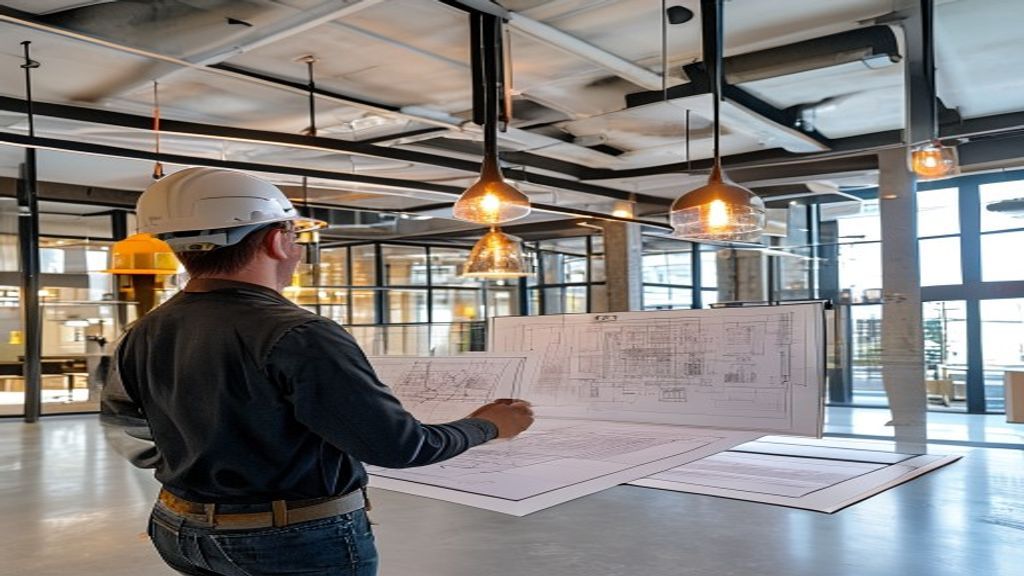
Interior fit-out project management is one of the most coordination-intensive disciplines in the built environment. Unlike structural engineering or MEP systems design — where technical complexity is the primary challenge — fit-out demands the simultaneous orchestration of aesthetic vision, functional performance, mechanical services, and the work of a dozen or more specialist subcontractors, all within a compressed timeline and frequently within a live building. Getting it right requires a structured approach to scope definition, programme management, and contractor coordination from the very first day of engagement.
At TechVisionEra Engineering, our interior decoration and fit-out project managers bring both design sensibility and engineering rigour to every project. We operate across commercial, hospitality, healthcare, and residential sectors, delivering fit-out programmes from remote design stages through to on-site completion — whether the project is in Kuala Lumpur, Riyadh, Istanbul, or Damascus. This article sets out the methodology we apply on every project, the tools we use, and the coordination principles that consistently deliver successful outcomes.
Step 1 — Defining the Fit-Out Scope of Work
Every fit-out project begins with a clear scope of work (SOW). Without one, cost overruns and programme delays are almost guaranteed. The SOW must distinguish between Category A fit-out — the base build including raised floors, suspended ceilings, basic MEP services, and fire detection — and Category B fit-out, which adds tenant-specific partitioning, finishes, bespoke joinery, furniture, audio-visual systems, and branded design elements. Conflating these two categories during tendering is one of the most common — and expensive — errors in the industry, leading to contractual disputes over which party is responsible for costs that were simply not allocated at the outset.
Our project managers begin every engagement with a detailed Employer's Requirements document that captures function, aesthetics, the budget envelope, and technical compliance requirements for every zone of the project. This document becomes the contractual basis for design, tendering, and construction — eliminating ambiguity that would otherwise surface as costly variations during the build phase. For projects linked to new-build structures, we align fit-out scope with structural loading capacities and MEP infrastructure at the earliest stage, ensuring that no fit-out element exceeds the slab load capacity or conflicts with a primary plant distribution route. Our on-site engineering teams confirm these interface conditions before procurement begins.
The scope definition stage also produces a full room data sheet (RDS) schedule covering every space type: finishes specification, acoustic performance targets, illuminance levels, data outlet density, HVAC supply and return positions, and access control requirements. This level of detail at scope stage saves weeks of design iteration and RFI cycles during construction, because contractors receive a fully coordinated brief rather than a concept scheme that still needs engineering resolution.
- Employer's Requirements document with functional and aesthetic briefs
- Category A vs Category B scope matrix with clear cost allocation
- Room Data Sheets for every space type in the project
- MEP infrastructure alignment with base-build systems confirmed early
- Structural loading check for raised access floors, mezzanines, and heavy joinery
- IT, AV, and security scope defined with specialist subconsultants
- FF&E (Furniture, Fixtures and Equipment) procurement schedule and budget
Building a Realistic Fit-Out Programme
Timeline management is where most fit-out projects fail. Clients and design teams routinely under-estimate the lead times for bespoke joinery, specialist glazing systems, and imported stone finishes — elements that routinely carry 8–14 week procurement cycles from order placement to site delivery. A realistic master programme must integrate design milestones, authority approval periods, procurement lead times, trade sequences, testing and commissioning periods, snagging, and handover — all mapped to the client's target occupancy date and built backwards from that fixed endpoint.
We use Primavera P6 and Microsoft Project for programme management on larger fit-out contracts, and cloud-based tools such as Asana or Notion-based dashboards for medium-size projects where the client team needs real-time visibility without specialist software. The programme is refreshed every week during construction, and a three-week look-ahead is issued to all trade contractors at every site coordination meeting. This near-term planning window is critical — it prevents the all-too-common scenario where one delayed trade blocks the access of five others, causing cascading delays that cannot be recovered without expensive acceleration measures.
Phasing strategy deserves particular attention on occupied-building fit-outs. Whether the project is a hotel room-by-room refurbishment, a hospital ward reconfiguration, or a phased office fit-out in a building with live tenants, the programme must sequence works to protect occupants, maintain fire escape routes at all times, and comply with dust and noise suppression requirements. Phasing plans must be agreed with the client's facilities management team before construction begins — not negotiated reactively as work progresses.
"A fit-out project without a three-week look-ahead programme is not a managed project — it is a controlled emergency waiting to happen."
Contractor Selection, Tendering, and Package Procurement
A mid-size commercial fit-out typically involves 8–12 specialist subcontractors working across partitioning, suspended ceilings, raised access flooring, electrical, mechanical, plumbing and drainage, fire protection, data and communications, audio-visual, signage, bespoke joinery, and decorating trades. Selecting and coordinating this supply chain is a full-time management activity — not a task to be delegated to the main contractor and forgotten.
Our procurement strategy begins with pre-qualification questionnaires (PQQs) that screen prospective contractors on financial stability, directly relevant project experience, quality management certification (ISO 9001), health and safety performance (ISO 45001), and current workload capacity relative to the proposed contract. We will not appoint a contractor simply because they offer the lowest price. A contractor who is overstretched or under-resourced will cause delays and quality defects that dwarf any initial cost saving. Competitive tendering is conducted against a fully detailed Bill of Quantities or specification to ensure genuine like-for-like comparison across bidders, with all queries handled through a formal tender query register so that every tenderer receives the same information.
Contract forms are not legal formalities — they are the operational framework that governs how variations are instructed, how delays are notified, and how disputes are resolved before they escalate. For fit-out works we typically use the NEC4 Engineering and Construction Short Contract or a bespoke subcontract based on the JCT Minor Works form, supplemented with a design responsibility matrix, a BIM Execution Plan, and detailed insurance and liability schedules. Every appointed contractor must sign the BIM Execution Plan before commencing design work, ensuring that all design information flows through the common data environment rather than through ad hoc email chains.
- Pre-qualification of all subcontractors against financial, technical, and safety criteria
- Competitive tendering against full Bills of Quantities with formal query register
- Design responsibility matrix covering every element of the fit-out scope
- BIM Execution Plan signed by all principal trade contractors before design commences
- NEC4 or JCT-based subcontract forms with clear variation and delay notification procedures
- Insurance requirements confirmed: public liability, professional indemnity, employer's liability
- Performance bonds and parent company guarantees on high-value or long lead-time packages
On-Site Coordination: Trade Interfaces, Sequences, and Daily Management
No fit-out trade contractor works in isolation. The suspended ceiling contractor cannot close a ceiling until the mechanical contractor has completed ductwork, the electrical contractor has run cable trays, the data contractor has pulled cable, the fire protection contractor has installed sprinkler heads, and the lighting contractor has set downlight boxes to the correct position. This sequence — repeated in every zone of every fit-out — requires daily coordination that goes far beyond a weekly progress meeting. The trades must be sequenced, their access must be managed, and their interfaces must be resolved in design before work begins on site.
Our project managers maintain a trade interface matrix that maps every zone of the project, identifies which trades must complete work before the next trade can enter, and flags lead-time dependencies requiring advanced scheduling action. We conduct a daily stand-up with trade foremen every morning — a focused 15-minute coordination meeting that resolves access conflicts, confirms permit-to-work status, allocates scaffold and hoist time, and issues the day's coordination instructions. This cadence has consistently proven more effective than contractor-to-contractor communication, which inevitably produces blame allocation rather than problem resolution.
Where architectural design involves complex interfaces — for example, where a bespoke feature wall interacts with concealed mechanical services, or where a structural opening must be created to install a prefabricated staircase — we resolve these through coordinated 3D BIM models before any work begins on site. Clash detection in the BIM environment eliminates the most common source of abortive work on fit-out projects: cutting open a finished ceiling to reroute a duct that was never coordinated in advance. Our BIM workflow integrates Autodesk Revit models from the architect, MEP engineer, and specialist subcontractors into a single federated model that serves as the live coordination tool throughout the construction phase.
Quality Assurance, Standards Compliance, and Inspection
Interior fit-out works must comply with a layered set of standards covering structural performance, fire compartmentation, acoustic performance, thermal comfort, accessibility, and electrical safety. The applicable standards vary significantly by jurisdiction: projects in the Gulf follow local authority building codes and typically reference NFPA 101 Life Safety Code and ASHRAE for MEP systems; European projects apply Eurocode standards and BS EN product standards; UK projects follow the Building Regulations Approved Documents; and many international projects blend requirements from multiple regulatory regimes. Understanding which standards apply — and where they conflict — is a specialist skill that our project managers bring to every project from the outset.
Our quality assurance process follows a Hold Point and Witness Point inspection plan (ITP) that requires physical sign-off at every critical stage before subsequent works can proceed. No floor screed is poured without checking the condition and completed status of underfloor services. No plasterboard partition is closed without confirming the internal framing dimensions, insulation specification, and fire stopping installation. No suspended ceiling tile is laid without first testing the HVAC, sprinkler, and data systems concealed above it. Every inspection is recorded on a digital platform, creating an auditable quality record that forms part of the project's O&M handover documentation.
- Hold Point and Witness Point ITP maintained for every trade package
- Acoustic testing (Rw, DnTw values) of demountable partition systems against design targets
- Fire stopping inspection and third-party certification behind all ceilings and partitions
- Illuminance verification (lux testing) at working plane against CIBSE LG7 or equivalent
- HVAC air balancing and commissioning in accordance with BSRIA BG2 or SMACNA
- Electrical testing and certification to BS 7671, IEC 60364, or applicable national standard
- Pre-handover snagging register with defect close-out tracked to practical completion
Remote Project Management and Digital Delivery
TechVisionEra Engineering delivers fit-out project management services to clients whose projects are geographically distant from our studio offices. For international clients, we establish a hybrid delivery model: design coordination, programme management, procurement administration, and contract management are conducted remotely via a BIM-connected common data environment; on-site management, inspection, and authority liaison are provided by locally appointed resident engineers who report directly to our lead project manager and follow our protocols, checklists, and inspection hold points without exception.
This hybrid model is not a compromise — for many project types it is superior to a fully on-site approach. Centralised design coordination eliminates the information silos that form when each trade contractor's design team works in isolation. A remote project manager maintains objective oversight without becoming embedded in the interpersonal dynamics of the site. And the digital paper trail — every RFI, drawing issue, variation instruction, and site inspection record held in a Common Data Environment (CDE) — provides complete auditability that protects both client and consultant throughout the project lifecycle and during any post-completion dispute.
Establish your Common Data Environment — such as Autodesk Construction Cloud, Aconex, or Procore — before appointing any contractor, and make CDE access a mandatory condition of every subcontract. Require all RFIs, technical submittals, drawings, site instructions, and inspection records to pass through the CDE. This single discipline eliminates the WhatsApp-and-email chaos that plagues most fit-out sites and creates an auditable, searchable record that is invaluable if defect liability or delay disputes arise at or after practical completion.
Handover, Snagging, and Post-Occupancy Performance
Practical completion is not the finish line — it is the beginning of the client's exposure to everything that was not done correctly during construction. A rigorous pre-handover snagging process typically identifies 200–500 defect items on a 1,000 m² commercial fit-out. Our approach is to begin snagging zone by zone from the fourth week of a fourteen-week programme — not in the final week — so that defects are identified and rectified while the responsible contractor is still mobilised on site and has financial motivation to act. A snagging list issued the week before practical completion is a list of negotiations; a snagging list issued eight weeks before is a list of workorders.
Handover documentation includes the full O&M manual, as-built drawings (BIM model updated to record the constructed position of every service), manufacturer warranties and guarantees for every specified product, maintenance schedules, commissioning certificates, and training records for the client's facilities management team. We also prepare a Planned Preventive Maintenance (PPM) schedule for all MEP systems and a finish maintenance guide for every specified material surface — stone, timber, glass, fabric, and coatings — so the client can protect their capital investment from the first day of occupation.
For clients who wish to track post-occupancy performance — occupant satisfaction, energy consumption, space utilisation density — we can scope IoT sensor integration linked to a live building management dashboard at the fit-out design stage, when the infrastructure to support it can be installed efficiently. This data informs future refurbishment decisions and provides measurable evidence of whether the original design brief was actually achieved by the completed fit-out. Contact Vetta to discuss how post-occupancy evaluation can be built into your fit-out scope from the outset, at no disproportionate additional cost.
Key Takeaway
Successful interior fit-out project management rests on three non-negotiable pillars: a rigorously defined scope that eliminates budget ambiguity before tendering; a realistic, trade-coordinated programme built backwards from the client's occupancy date; and disciplined daily interface management that keeps eight or more specialist trades working in sequence, not in conflict. Engage your project manager at the briefing stage — not after the main contractor has been appointed — and your fit-out will deliver on time, on budget, and to the quality standard your occupants will experience every day.

Frequently Asked Questions
Interior fit-out project management covers the full lifecycle from initial brief to post-handover: scope of work definition (Category A and B), employer's requirements documentation, contractor procurement and tendering, programme development, daily trade coordination on site, quality inspection and ITP management, variation control, and handover documentation including O&M manuals and as-built BIM models. A project manager is the single point of accountability for delivering the fit-out on time, on budget, and to the agreed quality standard.
A standard commercial office fit-out of 500–2,000 m² typically takes 12–18 weeks from contractor mobilisation to practical completion, plus 4–8 weeks of pre-construction design coordination and procurement. Larger or more complex projects — hospitality, healthcare, high-specification retail — may require 24–36 weeks or more. The most significant timeline risks are bespoke joinery lead times (8–14 weeks), imported stone or specialist glazing (6–12 weeks), and local authority approvals, which should be sequenced well before construction begins.
Category A (Cat A) fit-out refers to the base-build completion of a commercial space: raised access floors, suspended ceilings with a standard lighting grid, basic HVAC distribution, fire detection, and perimeter power and data. The space is functional but generic — a blank canvas. Category B (Cat B) fit-out transforms that blank canvas into a finished, branded, tenant-specific environment: bespoke partitions, specified finishes, custom joinery, furniture, audio-visual and IT infrastructure, branding elements, and any spatial modifications such as server rooms, breakout areas, or collaborative zones. Most fit-out project management engagements focus on Cat B, but the PM must understand and coordinate with the Cat A scope to avoid interface conflicts.
Scope creep is controlled through three mechanisms: a comprehensive scope of work and Employer's Requirements document agreed and signed before tendering; a formal variation instruction process requiring written approval before any additional work is carried out; and a contingency budget (typically 8–12% of the contract sum) reserved specifically for legitimate scope additions, so that approved changes are funded without disrupting the base budget. Any item not in the original scope must be priced, approved in writing, and its programme impact assessed before it is instructed. Our project managers enforce this discipline consistently — a variation approved verbally on site is the single most common cause of disputed final accounts.
Fit-out project management fees typically range from 3–8% of the total construction contract value, depending on project complexity, the level of on-site presence required, the degree of design coordination involvement, and whether the PM is also acting as contract administrator. On a $500,000 commercial fit-out, a PM fee of 5% represents $25,000 — a fraction of the cost of a single unmanaged scope dispute or programme delay. For international projects requiring both remote coordination and locally appointed resident engineers, fees are structured to reflect the dual-layer delivery model and are discussed transparently at the initial proposal stage.
Yes. Our hybrid remote delivery model is well-established and suitable for projects across the Middle East, North Africa, Southeast Asia, and Europe. Remote project management covers scope definition, design coordination via BIM, contractor procurement and contract administration, programme tracking, and variation management — all conducted through a Common Data Environment. On-site quality inspection, authority liaison, and day-to-day contractor coordination are provided by locally appointed resident engineers who work within our protocols and report to our lead project manager. We do not reduce quality standards for remote delivery; we engineer the delivery model to maintain them.
Our primary BIM authoring tool is Autodesk Revit, used for architectural fit-out modelling and MEP coordination. We federate models from all specialist subcontractors — mechanical, electrical, data, fire protection — into a single coordinated model using Autodesk Navisworks or BIM 360 Coordination for clash detection. All project information, including drawings, RFIs, submittals, and inspection records, is managed through Autodesk Construction Cloud or an equivalent Common Data Environment agreed with the client at the project outset. For smaller projects, simpler BIM coordination is conducted in Trimble SketchUp or Archicad depending on the design team's platform.
Effective multi-trade coordination relies on three tools used consistently: a trade interface matrix that maps every zone and specifies the mandatory sequence of trade access; a three-week look-ahead programme issued weekly to all contractors; and a daily stand-up meeting with trade foremen lasting no more than 15 minutes. All communication between trades flows through the project manager — direct contractor-to-contractor instruction-giving is prohibited as it bypasses the programme and creates instruction disputes. Access to restricted zones is controlled through a permit-to-work system, and shared resources such as scaffolding, hoists, and loading bays are scheduled on a weekly basis to prevent conflict.
Applicable standards depend on jurisdiction. In the Gulf region, NFPA 101 Life Safety Code, ASHRAE 62.1 (ventilation), and local municipality codes apply. In Europe, the suite of Eurocode standards governs structural elements, and BS EN 45545 applies to fire performance of materials in certain occupancy types. In the UK, the Building Regulations Approved Documents (Parts B, E, L, M) apply, alongside BS 7671 for electrical installations. For acoustic performance, ISO 16283 and BS EN ISO 10140 govern partition testing. Our project managers confirm the applicable compliance framework for every project during the scope definition stage and specify products and systems accordingly.
Occupied-building fit-out requires an approved method statement and phasing plan before any work begins, reviewed and accepted by both the building owner and the client's facilities management team. The phasing plan must maintain fire escape routes, segregate dust and noise from occupied areas using temporary hoarding and HEPA filtration, restrict noisy works to agreed out-of-hours windows, and maintain operational access to all active plant rooms. A dedicated site safety manager is required on any occupied-building project. Works programmes are structured in discrete phases, each with its own completion milestone, so that completed zones can be returned to use as the project progresses.
Under a properly drafted NEC4 or JCT subcontract, a contractor who fails to achieve a programme milestone is required to submit a recovery plan within 5–10 working days showing how they will recover the delay without additional cost to the client. If the delay is the contractor's responsibility — not caused by a client instruction, a late design issue, or an employer risk event — no extension of time is granted and the contractor must accelerate at their own cost. If delay damages (liquidated and ascertained damages) are specified in the contract, these become payable from the date of delay. Our project managers maintain contemporaneous records of all delay events so that liability is established on facts, not assertions.
MEP coordination during fit-out begins in the design stage with a federated BIM model that identifies clashes between ductwork, pipework, cable trays, sprinkler systems, and the architectural ceiling and partition design. Once clashes are resolved in the model, a set of coordinated MEP installation drawings is issued to contractors — these are not the engineer's design drawings, but the contractor's coordinated shop drawings that show the exact routed and sized installations in every ceiling void. On site, MEP trades follow a strict sequence: ductwork first, followed by pipework, then cable trays and containment, then data cabling, then sprinkler drops, then ceiling grid. No ceiling is closed until MEP commissioning engineers have witnessed and signed off the services above.
A complete fit-out handover package includes: as-built drawings and the updated federated BIM model; the full O&M manual with operating instructions for every installed system; manufacturer warranties and guarantees for all specified products; commissioning certificates for HVAC, electrical, fire detection, access control, and audio-visual systems; a Planned Preventive Maintenance schedule specifying service intervals and responsible parties; training records confirming that the client's facilities team has been instructed on system operation; the final snagging register with all items closed out; and the health and safety file required under CDM regulations (UK) or equivalent local legislation. This package is assembled progressively throughout the project, not assembled in the final week.
Our contractor selection process follows a three-stage approach. First, pre-qualification: contractors are screened against minimum financial thresholds, relevant project experience (same sector, similar scale, same fit-out specification), quality and safety certification, and current workload capacity. Second, competitive tender: pre-qualified contractors are invited to price against a complete Bill of Quantities or specification, with all queries managed through a formal register ensuring every tenderer has the same information. Third, interview and appointment: the two or three most competitive tenders are reviewed in a post-tender interview where programme, resource plan, and quality plan are discussed before appointment. Price is a major but not the only factor in our recommendation.
The five most common causes of fit-out budget overruns are: (1) inadequate scope definition before tendering, leading to variation claims throughout construction; (2) bespoke item lead times not built into the programme, causing delay and associated costs; (3) MEP coordination failures requiring abortive demolition of finished ceilings or partitions; (4) contractor insolvency mid-project, requiring emergency re-procurement at above-market rates; and (5) client-driven design changes after construction has commenced, which carry a disproportionate cost premium because later changes cost more to implement. Addressing all five at the pre-construction stage — through rigorous scope definition, BIM coordination, thorough contractor pre-qualification, and a robust change control process — is the most reliable way to protect the construction budget.
Furniture, Fixtures and Equipment (FF&E) procurement is managed in parallel with the construction programme, not sequentially after it. Our FF&E schedule identifies every item requiring procurement — furniture, loose equipment, branded elements, artwork, and accessories — with its confirmed lead time, delivery date, and installation sequence. For bespoke items such as custom-upholstered seating, branded reception furniture, or specified lighting fixtures, procurement is initiated within the first two weeks of the project to protect against long lead times. Delivery to site is programmed for the penultimate week of construction, so that FF&E installation occurs after all trades have completed and the space has been cleaned — not during active construction, where items are inevitably damaged.
Yes. TechVisionEra Engineering has direct experience delivering projects in challenging operating environments including Syria, Iraq, and Yemen. For on-site delivery in these regions, we work through locally established resident engineer networks who operate under our project management protocols and reporting structures. Remote design coordination, BIM modelling, specification writing, and procurement support are delivered from our studio offices. We are experienced in the procurement constraints, material availability limitations, and contractor market characteristics specific to these markets, and we structure our delivery models accordingly. Contact us to discuss your specific project location and requirements.