
Commercial buildings demand precision-engineered HVAC systems that balance occupant comfort, regulatory compliance, and long-term energy performance. Whether you are delivering a high-rise office tower in Dubai, a hospital complex in Riyadh, or a retail centre in Amman, the quality of your HVAC design directly determines operational costs for the next 25 years. At TechVisionEra Engineering's MEP division, we deliver ISO-compliant, BIM-coordinated HVAC design packages serving international clients across the Gulf, Levant, and European markets.
This guide examines the three technical pillars of commercial HVAC engineering: accurate load calculations, code-compliant duct sizing, and energy efficiency optimisation — the foundations every project must get right before a single piece of equipment is specified.
Understanding HVAC Load Calculations for Commercial Buildings
A cooling and heating load calculation is the mathematical process of quantifying the thermal energy a building gains or loses under peak design conditions. It accounts for solar heat gain through glazing, conductive heat transfer through opaque envelope elements, internal heat generated by occupants, lighting fixtures, and equipment, uncontrolled infiltration air, and the mandatory outdoor air ventilation required by ASHRAE Standard 62.1 or EN 16798. The resulting peak load — expressed in kilowatts (kW) or British Thermal Units per hour (BTU/h) — defines the minimum thermal capacity the HVAC plant must deliver to maintain design-condition indoor temperatures throughout occupied hours.
Undersizing the calculated load leads to overheating or undercooling, persistent tenant complaints, and premature equipment failure through continuous overload. Oversizing — arguably the more common mistake in commercial practice — wastes capital expenditure, increases operating costs, and creates chronic humidity control problems in warm, humid climates because oversized equipment short-cycles before it has time to adequately dehumidify supply air. Both ASHRAE Handbook of Fundamentals and CIBSE Guide A define industry-standard methodologies for heat gain and heat loss calculation, and TechVisionEra engineers are trained to both standards for seamless international project delivery.
Modern load calculations are performed using validated simulation software such as HAP (Hourly Analysis Program), IES VE, or Carrier E20-II, applying the Heat Balance Method (HBM) or Radiant Time Series (RTS) approach as specified by ASHRAE Standard 140. For projects where energy modelling is required — LEED, BREEAM, or Estidama Pearl — the same software platform feeds directly into the energy simulation, eliminating data-entry errors and ensuring full consistency between the mechanical design model and the green-building compliance submission. TechVisionEra provides stamped load calculation reports as a formal project deliverable, enabling authority-having jurisdiction (AHJ) review and value engineering discussions with clear numerical backing.
Duct Sizing: Methods, Velocity Limits, and Pressure Drop Management
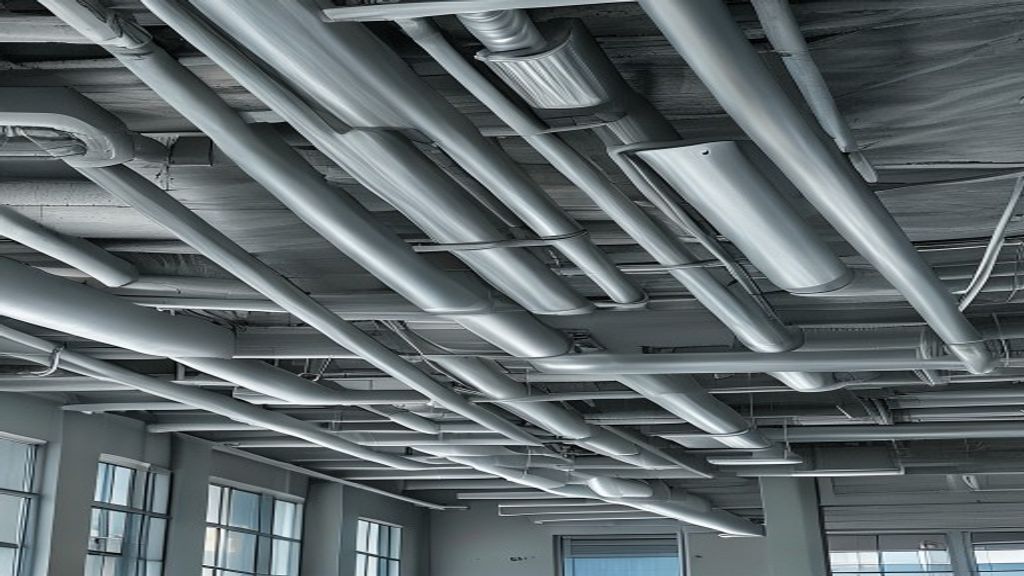
Once room-by-room airflow quantities are derived from the load calculation, the distribution network must be sized to deliver those flows at acceptable velocities without generating excessive noise or energy-wasting pressure drop. The three principal duct sizing methods used in commercial practice are the Equal Friction Method, the Static Regain Method, and the velocity-reduction approach. TechVisionEra's MEP team defaults to the Equal Friction Method for most commercial office and retail projects, applying friction rates of 0.8–1.2 Pa/m for main supply ducts and limiting maximum duct velocities to 7–8 m/s to meet the noise criteria prescribed by ASHRAE HVAC Applications Chapter 48 and CIBSE Guide B.
Duct construction quality and leakage class are as critical as geometric sizing. A low-pressure system sized perfectly on paper but exhibiting a leakage rate of 15% wastes between 10 and 20% of total fan energy before conditioned air reaches a single terminal unit. TechVisionEra specifies SMACNA duct construction standards and requires Duct Leakage Class B (maximum 4 L/s per m² at 250 Pa) on all commercial supply main trunks, with duct leakage pressure testing mandated in the commissioning plan at practical completion. This requirement is embedded in TechVisionEra's outline specification templates and cannot be value-engineered out without a formal design change notice.
A duct system sized for peak efficiency on paper can waste 20% of fan energy through poor workmanship and leakage — specification without site enforcement is not engineering, it is optimism.
Variable Air Volume (VAV) systems introduce a further layer of complexity: the duct network must be sized not only for design-day peak flow but also for the minimum flow condition, where static pressure in the system is highest and VAV box pressure-independent controllers must compensate without generating excessive terminal noise. TechVisionEra's BIM-coordinated duct layouts, produced in Revit MEP, embed pressure drop calculations directly in the model, so any routing change automatically flags a velocity or pressure violation — eliminating the manual recalculation cycle that routinely delays traditional 2D CAD workflows and introduces undetected design errors before construction issue.
HVAC Equipment Selection: Chillers, AHUs, FCUs, and VRF Systems
Equipment selection in commercial HVAC is not simply a matter of choosing the unit with the highest nameplate COP (Coefficient of Performance). It requires matching equipment performance curves to the actual load profile, local climate zone, and building operating schedule. A chiller rated at COP 6.0 at full load may yield an IPLV (Integrated Part Load Value) of only 4.8 in a climate where the building spends 70% of operating hours at 40–60% partial load — making a machine with a lower rated COP but a superior part-load curve the better lifecycle choice by a significant margin.
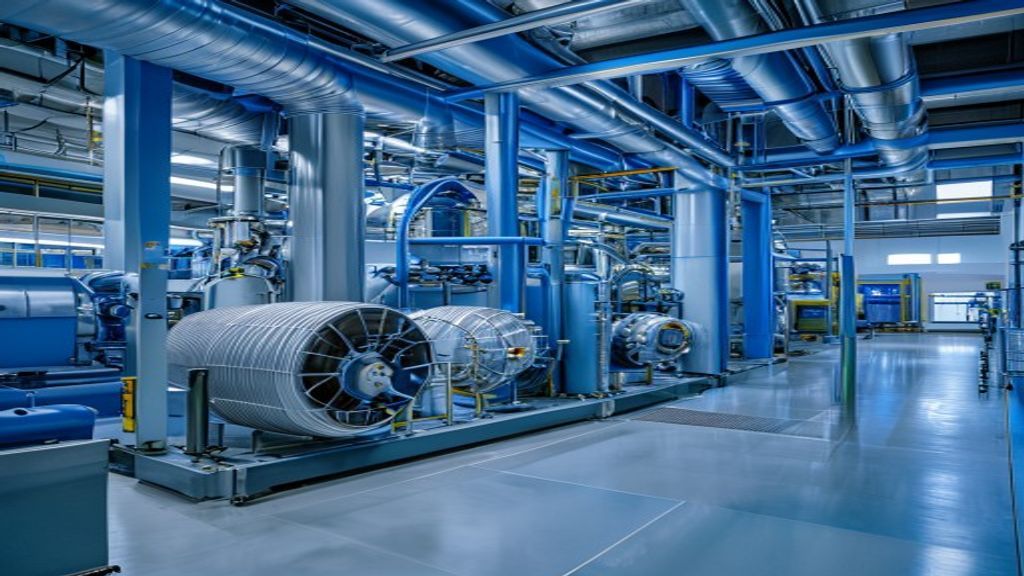
For medium-to-large commercial buildings above 1,000 m² conditioned floor area, chilled water systems using centrifugal or magnetic-bearing chillers deliver the best lifecycle economics through high part-load efficiency and straightforward central maintenance. For smaller footprints or retrofit situations, multi-split VRF (Variable Refrigerant Flow) systems offer installation flexibility and individual zone control without the complexity of a chilled water distribution network and associated pump energy. TechVisionEra's MEP engineering services cover full equipment selection and tender documentation for both system types, including performance specification, detailed equipment schedules, and compliance verification against ASHRAE 90.1 minimum efficiency tables.
Air Handling Units (AHUs) and Fan Coil Units (FCUs) are selected against room loads with defined supply air temperature differentials — typically 8–12°C delta-T for cooling and 15–20°C for heating modes. TechVisionEra includes manufacturer selection software outputs in every design package: certified performance curves, acoustic power data, and coil heat duty calculations. This gives procurement teams the technical evidence to evaluate contractor submittals objectively and reject non-compliant equipment substitutions before they reach site.
Energy Efficiency Strategies: ASHRAE 90.1, Eurocode, and Net-Zero Pathways
Energy efficiency in commercial HVAC is codified in several parallel frameworks depending on project jurisdiction. ASHRAE Standard 90.1 — the Energy Standard for Buildings Except Low-Rise Residential Buildings — sets prescriptive minimum efficiencies for chillers, boilers, fans, pumps, and duct insulation across North American and Gulf market projects. EN 15232 (Energy Performance of Buildings: Impact of Building Automation) and EN 16798 govern European projects, defining indoor environment categories and HVAC control efficiency classes from Class D (non-classified) through to Class A (high energy performance). Both standards increasingly converge on the same destination: buildings that can demonstrate measurable operational energy consumption in service, not merely paper compliance at design stage.
Beyond minimum compliance thresholds, genuinely efficient commercial HVAC design incorporates demand-controlled ventilation (DCV) via CO₂ sensors to reduce outdoor air intake during periods of low occupancy, heat recovery ventilation (HRV/ERV) achieving combined sensible and latent efficiencies above 70%, variable-speed drives (VSDs) on all pumps and fans above 0.75 kW, and free cooling economiser cycles that exploit ambient conditions to offset compressor run hours by 15–25% in transitional climates such as the Levant and Eastern Mediterranean region. TechVisionEra's on-site supervision teams verify that every energy-saving measure is commissioned and functioning correctly — not merely installed and left unverified during a rushed practical completion process.
When specifying chillers for Middle Eastern or Mediterranean climates, always request the manufacturer's IPLV performance curve at 35°C entering condenser water temperature rather than the standard AHRI rating condition of 29.4°C. Real-world part-load efficiency in warm climates can be 15–20% lower than the published nameplate figure — a difference that materially changes the 25-year lifecycle cost comparison between competing machines.
BIM-Coordinated HVAC Design: Clash Detection and Construction Readiness
Building Information Modelling (BIM) has transformed commercial HVAC design from a two-dimensional drawing exercise into a three-dimensional, data-rich coordination discipline. TechVisionEra delivers all HVAC designs as LOD 350 Revit MEP models, meaning every duct run, pipework circuit, fitting, and equipment item is modelled at the level of detail required for direct construction installation — including maintenance clearance zones, access panel envelopes, and hanger point locations. This model maturity virtually eliminates the costly site clashes between HVAC ductwork, structural beams, and plumbing mains that account for a disproportionate share of construction rework costs on commercial projects in every market we serve.
Coordination is conducted through federated model reviews using Autodesk Navisworks, with clash detection reports issued to structural, architectural, and plumbing design teams prior to each design gate review. The result is a construction-issue drawing set that contractors can follow without improvising field solutions — critical in markets where skilled MEP installation trades are in short supply and site engineering resources are limited. TechVisionEra's structural engineering team is fully integrated into the BIM coordination workflow, ensuring penetration sleeves, equipment housekeeping pads, and plant room point loading are resolved at design stage, not during the construction programme.
For remote international clients, TechVisionEra provides BIM 360 cloud model access, enabling project owners, local authorities of jurisdiction, and construction managers to interrogate the 3D model and issue formal RFIs without requiring specialist CAD software licences. This open-access coordination model is particularly valuable for clients managing concurrent projects across the Gulf and Levant regions. Architectural integration — resolving plant room locations, ceiling void depths, and façade penetrations — is handled within the same BIM environment, preventing the costly late-stage coordination changes that arise when MEP and architectural teams work in isolated drawing environments.
HVAC Commissioning, TAB, and Handover Documentation
Design quality is only realised in service if the installed system is commissioned rigorously. TechVisionEra's HVAC packages include a comprehensive commissioning plan aligned with ASHRAE Guideline 1.1 and CIBSE Commissioning Code A, covering system pre-commissioning checks, balanced airflow procedures, control sequence verification, and TAB (Testing, Adjusting, and Balancing) documentation requirements. Every system is required to achieve airflow balance within ±10% of design values at each terminal unit before practical completion can be certified by the engineer of record. The standard TechVisionEra HVAC design and supervision package delivers the following documented outputs:
- Heat gain and heat loss calculations (ASHRAE HBM/RTS method) with room-by-room airflow and plant capacity summary
- System selection report with certified equipment performance data and lifecycle cost comparison
- LOD 350 Revit MEP duct and pipework coordination model with embedded pressure drop data
- Single-line schematic diagrams, equipment schedules, and construction-issue drawing set
- Duct construction and thermal insulation specification to SMACNA standards with leakage class requirements
- Commissioning plan and TAB requirements document per ASHRAE Guideline 1.1 and CIBSE Code A
- Energy compliance report (ASHRAE 90.1 prescriptive path or Eurocode EN 15232 as applicable)
- Operation and Maintenance manual template with equipment warranty schedule and spare parts list
Handover documentation also includes as-built BIM models updated to reflect any field modifications made during construction, seasonal commissioning schedules that verify heating performance in winter conditions and full cooling performance in summer — because a system commissioned in spring cannot demonstrate its heating limitations until the first cold season — and video-documented commissioning records for clients unable to attend site. For clients in Syria and the broader Levant region, TechVisionEra's on-site engineering teams can conduct or formally witness commissioning activities directly. Remote international clients receive identical documentation quality plus BIM-linked digital O&M portals. Contact TechVisionEra to discuss your project's HVAC design and commissioning requirements.
Key Takeaway
Successful commercial HVAC design is a chain of precision: accurate load calculations feed correctly sized duct networks, which support right-sized equipment, which is controlled intelligently for sustained energy efficiency. Breaking any link in that chain — through oversized equipment, undersized ducts, or un-commissioned controls — erodes both occupant comfort and operational economics across the building's entire 25-year lifecycle. TechVisionEra Engineering delivers every link in that chain, from concept load study through BIM-coordinated construction documents to on-site commissioning verification, for clients worldwide.
Frequently Asked Questions
A commercial HVAC load calculation quantifies all thermal gains and losses acting on a building under peak design conditions. It covers solar heat gain through glazing (by orientation and time of day), conductive heat transfer through walls, roofs, and floors, internal heat generated by occupants, lighting, and equipment, uncontrolled infiltration, and the latent and sensible heat load of mandatory outdoor air ventilation. The calculation produces a room-by-room cooling and heating load summary, a zone airflow schedule, and a plant capacity statement used to select chillers, AHUs, FCUs, and boilers. TechVisionEra uses ASHRAE Heat Balance Method (HBM) or Radiant Time Series (RTS) in HAP or IES VE software, with outputs provided as a formal stamped report.
For a typical commercial office or retail building of 2,000–10,000 m², TechVisionEra's HVAC design programme runs 6–10 weeks from approved architectural layout to construction-issue BIM drawings. This covers load calculation (1–2 weeks), equipment selection and system schematic (1 week), BIM duct and pipework modelling with clash coordination (2–4 weeks), and drawing issue with specification (1 week). Larger projects, phased developments, or projects requiring energy modelling for LEED or BREEAM submission will require additional time. A detailed programme with design gates is provided at project kick-off.
TechVisionEra uses industry-validated software throughout the HVAC design process. Load calculations are performed in HAP (Hourly Analysis Program) by Carrier or IES VE, both of which apply ASHRAE-compliant HBM or RTS methods. Duct layout and pipework coordination are produced in Autodesk Revit MEP to LOD 350, with clash detection conducted in Autodesk Navisworks. Energy compliance reports are generated from the same simulation model used for equipment selection, ensuring data consistency across deliverables. For LEED, BREEAM, or Estidama submissions, full EnergyPlus or eQUEST energy models are developed as an additional service.
ASHRAE Standard 90.1 is the primary energy efficiency standard for commercial HVAC in North American and Gulf markets, setting prescriptive minimum equipment efficiencies (COP, EER, IPLV) and envelope requirements for each climate zone. The Eurocode HVAC framework uses EN 15232 (impact of building automation on energy performance) and EN 16798 (indoor environment input parameters), which focus more on ventilation rates, thermal comfort categories, and control system efficiency classes (A through D) rather than equipment COP alone. Both standards are increasingly aligned in intent — demonstrable operational energy performance — but the specific compliance pathways and documentation formats differ. TechVisionEra is fluent in both frameworks and can deliver dual-compliance designs for projects seeking both Gulf authority approval and European green-building certification.
Commercial HVAC design fees depend on building size, system complexity, scope of BIM deliverables, and the level of energy compliance documentation required. For a standalone HVAC design package (load calculations, duct and pipework drawings, equipment schedules, and specification) on a 2,000–5,000 m² commercial building, indicative fees typically range from USD 8,000 to USD 25,000. Full MEP packages including plumbing, fire suppression, and electrical are more cost-effective than individual discipline commissions. Contact TechVisionEra for a fixed-fee proposal based on the project brief, as fees are transparent and agreed upfront with no variable billing.
A VRF (Variable Refrigerant Flow) system uses refrigerant as the heat transfer medium, circulating it directly between an outdoor condensing unit and multiple indoor fan coil units through small-bore copper pipework. It is compact, flexible, and well-suited to buildings below approximately 1,000 m² or where a central plant room is not available. A chilled water system uses water as the heat transfer medium between a central chiller plant and AHUs or fan coils, with larger pipe diameters but significantly higher efficiency at scale and better lifecycle economics for buildings above 2,000–3,000 m². Chilled water systems also offer simpler refrigerant containment (refrigerant stays in the chiller machine room) and easier maintenance access. TechVisionEra designs both system types and provides comparative lifecycle cost analysis to help clients select the optimal solution for their specific building and usage profile.
Yes. TechVisionEra's core HVAC engineering capability is fully remote-deliverable. Load calculations, BIM duct modelling, specification writing, equipment selection, energy compliance reports, and construction-issue drawing packages are all delivered digitally via BIM 360 cloud access, PDF drawing sets, and native Revit model files. Regular design review meetings are conducted via video conference with screen-shared model walkthroughs. TechVisionEra has successfully delivered HVAC design packages for projects in Saudi Arabia, UAE, Jordan, Lebanon, Libya, and Europe without requiring a physical office presence in those markets. For projects in Syria and the Levant requiring on-site presence, TechVisionEra's local engineering team is available for site supervision, inspections, and commissioning oversight.
TechVisionEra delivers HVAC designs at LOD 350 (Level of Development 350) in Autodesk Revit MEP. LOD 350 means every duct, pipe, fitting, equipment item, and support hanger is modelled at the geometry and data level required for construction installation coordination — including clearance zones, maintenance access envelopes, and connection point data. This level of model detail enables automated clash detection in Navisworks against structural, architectural, and other MEP discipline models, producing quantified clash reports at each design gate. For projects where the client requires BIM Execution Plan (BEP) compliance, TechVisionEra prepares the BEP at project start and maintains CDE (Common Data Environment) discipline through BIM 360 or an agreed project platform.
TechVisionEra's default method for commercial office and retail HVAC duct sizing is the Equal Friction Method, applying a friction rate of 0.8–1.2 Pa/m on main supply trunk ducts and 0.8–1.0 Pa/m on branch runs. Maximum duct velocities are limited to 7–8 m/s on main trunks and 4–5 m/s on branch supply ducts to meet ASHRAE and CIBSE noise criteria for occupied commercial spaces (typically NC-35 to NC-40). For specialist applications such as hospital operating theatres, broadcast studios, or laboratory environments with stringent acoustic requirements, lower velocities and the Static Regain Method are employed. All duct sizing calculations are embedded directly in the Revit MEP model using the built-in pressure drop analysis tools, ensuring any geometry change triggers an automatic flag for engineer review.
Energy efficiency in a commercial HVAC system is achieved through a combination of correct sizing, high-efficiency equipment selection, intelligent controls, and verified commissioning. Key measures include: using demand-controlled ventilation (DCV) via CO₂ sensors to reduce outdoor air during low-occupancy periods; specifying variable-speed drives (VSDs) on all fans and pumps above 0.75 kW; selecting chillers based on IPLV (not just full-load COP) for the specific climate; incorporating heat recovery ventilation (HRV/ERV) with efficiency above 70%; and enabling free cooling economiser cycles where climate allows. Beyond specification, energy efficiency requires correct commissioning — VSDs that are bypassed, economisers that are disabled, and control setpoints that are never adjusted will eliminate theoretical savings entirely. TechVisionEra's commissioning plans mandate functional testing of every energy-saving feature before practical completion.
TechVisionEra's commissioning plans are aligned with ASHRAE Guideline 1.1 (HVAC&R Technical Requirements for the Commissioning Process) and CIBSE Commissioning Code A (Air Distribution Systems). The commissioning programme covers pre-commissioning checks (ductwork pressure testing, equipment installation verification, controls wiring inspection), system balancing and TAB (Testing, Adjusting, and Balancing) to achieve airflow within ±10% of design values at every terminal, control sequence functional testing, performance verification against design load conditions, and seasonal commissioning to verify both summer cooling and winter heating performance. TAB reports, control loop test records, and performance data are compiled in the O&M handover package and linked to the as-built BIM model.
TechVisionEra's standard HVAC design package includes: stamped load calculation report (room-by-room heat gain/loss with plant capacity summary); system selection report with equipment performance data and lifecycle cost analysis; LOD 350 Revit MEP coordination model with pressure drop calculations; construction-issue duct layout, pipework, and equipment arrangement drawings; single-line schematic diagrams; full equipment schedule with performance specifications; duct and insulation specification to SMACNA standards; commissioning and TAB requirements document; energy compliance report (ASHRAE 90.1 or EN 15232); and O&M manual template with warranty schedule. Clash detection reports from Navisworks coordination reviews are included as intermediate deliverables at each design gate.
Yes. TechVisionEra has a local engineering presence in Syria and can provide on-site HVAC design supervision, construction inspection, and commissioning oversight for projects in Damascus, Aleppo, Latakia, Homs, and other cities. On-site services include reviewing contractor shop drawings against the approved design, inspecting ductwork installation quality, witnessing duct leakage tests, overseeing TAB activities, and verifying control system commissioning. For international clients developing projects in Syria, TechVisionEra's on-site team acts as the client's eyes and ears, filing regular inspection reports with photographic documentation. For projects elsewhere in the Levant — Jordan, Lebanon, Iraq — TechVisionEra can mobilise site supervision teams on a project basis.
The most frequently encountered HVAC design failures TechVisionEra identifies during design reviews include: oversized equipment resulting from arbitrary safety factors added to already-conservative calculations; duct systems sized without considering pressure drop at fittings and transitions (leading to starved terminal units on long branch runs); missing or inadequate duct insulation on supply air mains in unconditioned ceiling voids (causing condensation and thermal gain); specifying chillers at AHRI standard rating conditions instead of actual site condenser water temperatures; no demand-controlled ventilation in spaces with variable occupancy such as conference rooms and auditoria; and controls sequences that are theoretically correct on paper but untested during commissioning. Each of these failures is preventable through rigorous calculation, specification, and commissioned verification — the three outputs TechVisionEra treats as non-negotiable in every project delivery.
HVAC design has significant interdependencies with both structural and architectural disciplines that must be resolved before construction issue. Structurally, HVAC plant rooms must accommodate equipment weight and dynamic loading from compressors and fans, roof-mounted condensers require structural framing and vibration isolation, and duct penetrations through shear walls or transfer beams require coordinated sleeve locations and fire damper positions. Architecturally, ceiling void depth determines the maximum duct depth available, plant room locations affect architectural massing and façade penetration points, and diffuser and grille positions must align with ceiling module and interior design intent. TechVisionEra's integrated team — spanning structural, architectural, and MEP disciplines — resolves these interdependencies within the BIM coordination model, ensuring all issues are closed before construction commences rather than resolved reactively on site.
Yes. TechVisionEra has experience delivering HVAC designs aligned with LEED v4 (ASHRAE 90.1 Energy and Atmosphere credits), BREEAM International (Ene 01 energy performance and Hea 02 indoor air quality credits), and Estidama Pearl 2 for Abu Dhabi projects. Green building compliance for HVAC typically requires: an energy model demonstrating performance improvement over the ASHRAE 90.1 baseline; enhanced indoor air quality ventilation rates per ASHRAE 62.1; enhanced filtration to MERV-13 or better; CO₂ monitoring for DCV in densely occupied spaces; and commissioning documentation aligned with ASHRAE Guideline 0. TechVisionEra coordinates the energy modelling, specification, and commissioning deliverables required for credit submission, and can liaise directly with LEED or BREEAM assessors on the client's behalf.